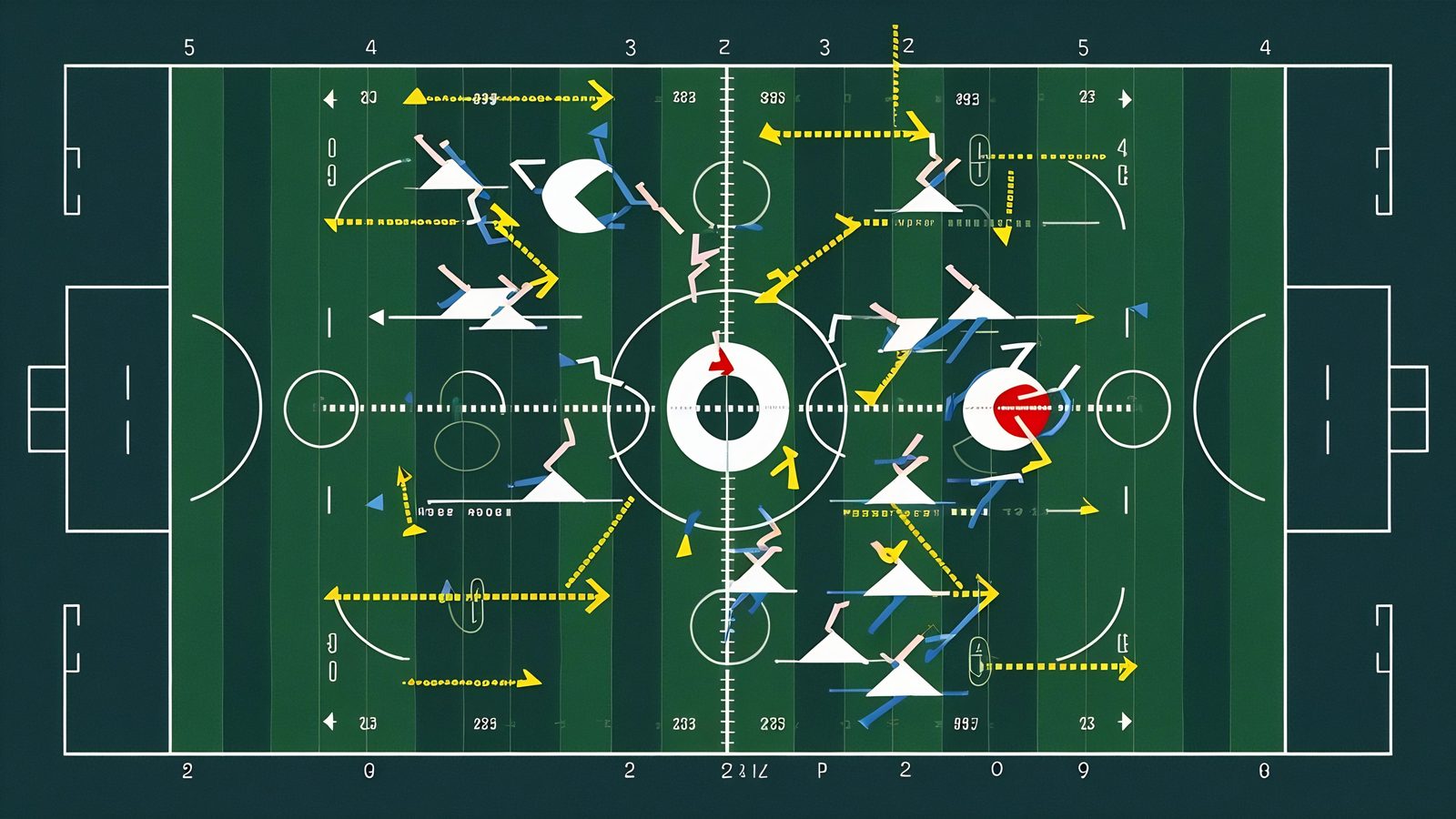
Defending in short format browser football is the skill that separates consistent winners from streaky players. Most players default to attacking because the time pressure and scoring objective encourage aggressive play. But in a format where a single goal often decides the match, preventing that goal is mathematically identical to scoring one. This guide covers how to think about defensive space, why positional discipline outperforms reactive chasing, and how to manage the transition from defence to attack without leaving yourself exposed. For attacking tactics, see Strategy. For shot timing from the attacker’s perspective, read the shot timing guide.
Thinking About Space Defensively
Defensive play in browser football is not about tracking a ball or following an opponent’s movement. It is about controlling the spaces where shots are most effective. The pitch has zones where goals are scored frequently and zones where they are scored rarely. Understanding this distribution lets you prioritise coverage of high threat zones rather than spreading defensive attention evenly.
In most browser football implementations, the highest threat zone is directly in front of the goal within shooting range. The threat diminishes as angle increases and as distance grows. Defensive positioning should reflect this heat map: cover the centre first, the near angles second, and the wide angles last.
This spatial approach is more efficient than ball following because it reduces the number of positional adjustments required. If you position to cover the highest probability scoring zones, you are already in a good defensive position for most shot attempts. You only need to adjust when the attacker moves to an unusual angle, which reduces your decision load during fast play.
Why Positional Discipline Outperforms Reactive Chasing
Reactive chasing means moving your defensive position in response to the opponent’s movement. They go left, you follow. They go right, you follow. This approach feels intuitive but it has a fundamental problem: you are always behind.
The opponent decides where to move before they move. You see their movement and then respond. This means you are always reacting to information that is already slightly old. If the opponent is decent at mixing up their movement patterns, reactive chasing leads to constant positional compromise.
Positional discipline means maintaining coverage of high threat zones regardless of where the opponent moves. Instead of following the attacker, you cover the space the attacker wants to shoot from. This reverses the dynamic: instead of chasing the opponent, you are forcing the opponent to beat your coverage.
The practical difference is visible in match results. Players who chase reactively concede goals when opponents change direction quickly or feint to draw the defender out of position. Players who maintain positional discipline concede fewer goals because the attacker must find an unusual angle to beat the coverage, and unusual angles produce lower probability shots.
Transition Management
The most dangerous defensive moments in short format football are transitions. A transition happens when play switches from attack to defence, typically after a failed shot attempt or a lost possession. During transitions, your positioning is often compromised because you committed resources forward during the attack.
Managing transitions defensively requires two habits. First, never fully commit to an attack. Always maintain some defensive coverage even while attacking. This reduces the severity of the positional compromise when the transition occurs. Second, prioritise recovering central defensive position during transitions rather than trying to immediately counter attack. The temptation to turn a transition into a counter is strong, but if your defensive coverage is compromised, you are vulnerable to being scored on before your counter materialises.
The best transition defenders recognise the transition moment instantly and begin repositioning before the opponent capitalises on the temporary gap. This recognition speed comes from experience. After playing dozens of matches, you develop a sense for when an attack is about to fail and you can begin the defensive recovery before the formal transition occurs.
Angle Denial
Angle denial is the specific tactical technique of positioning to remove the attacker’s best shot angles. Instead of trying to block shots reactively, you position to make the most dangerous angles unavailable before the shot is attempted.
Effective angle denial requires understanding which angles produce goals most frequently and positioning to block those specific angles. In practice, this means covering the direct centre line and the near post angle, which are the two highest probability scoring paths in most browser football implementations.
When you deny the primary angles, the attacker is forced into secondary angles that have lower conversion rates. Even skilled attackers struggle to score consistently from wide angles, which means your defensive positioning is doing the work of reducing their scoring probability before the shot is even attempted.
The limitation of angle denial is that it requires correct prediction of the attacker’s preferred shot angle. If the attacker is unpredictable, you need to default to central coverage which partially denies all angles rather than fully denying specific ones. Against predictable opponents, targeted angle denial is devastatingly effective. Against unpredictable opponents, broad central coverage is safer.
Defending a Lead
Defending a one goal lead in the final phase of a short format match is one of the hardest tactical situations in browser football. The trailing opponent will increase their attacking intensity, the time pressure creates urgency, and the temptation to try to extend the lead conflicts with the strategic value of protecting it.
The correct approach in most situations is to play conservative defence with minimal risk. Cover the high probability zones. Avoid transitions by not committing to attacks. Accept that the match will feel uncomfortable for the final phase and trust that your positional discipline will hold.
The exception is when the opponent’s increased attacking intensity creates clear counter attacking opportunities with minimal defensive risk. If the opponent over commits to an attack and leaves a direct counter path open, taking that counter can end the match definitively. But this should be the exception, not the default approach.
The psychological challenge of lead defence is real. It feels passive. It feels like you are giving up control. It feels like you should be doing something more active. But the mathematical reality is that in a match where one goal decides the outcome, protecting that goal is the highest value action available.
For the broader strategic context, see Strategy. For match format details that shape defensive approach, visit Match Modes.